Jacob Seifert, Ph.D.
Software and Algorithms Architect developing inspection instruments at the intersection of computational imaging, optics, machine learning, and engineering leadership.
I am Software and Algorithms Architect at AIM Solutions in Eindhoven, where we develop semiconductor metrology hardware. I lead the software side of the company and help it grow.
Before AIM, I worked as a postdoctoral researcher in computational imaging and ptychography after completing my Ph.D. at Utrecht University.
Weblinks to my projects and publications
Check out my work on: Google Scholar | YouTube | GitHub | LinkedIn | Email
More Content
Current Work
AIM Solutions (since 2026)
AIM Solutions in Eindhoven is an early-stage deep-tech startup developing semiconductor metrology hardware. I joined in early 2026 as Software and Algorithms Architect, leading the software side of the company and helping it grow.
My focus areas:
- Software and algorithm architecture for the computational platform behind the instrument.
- Engineering practices and DevOps, including development guidelines, CI workflows, and developer tooling.
- Cross-disciplinary collaboration with the optics, embedded, and integration teams.
Previous Projects
Auto-Differentiable Ptychography
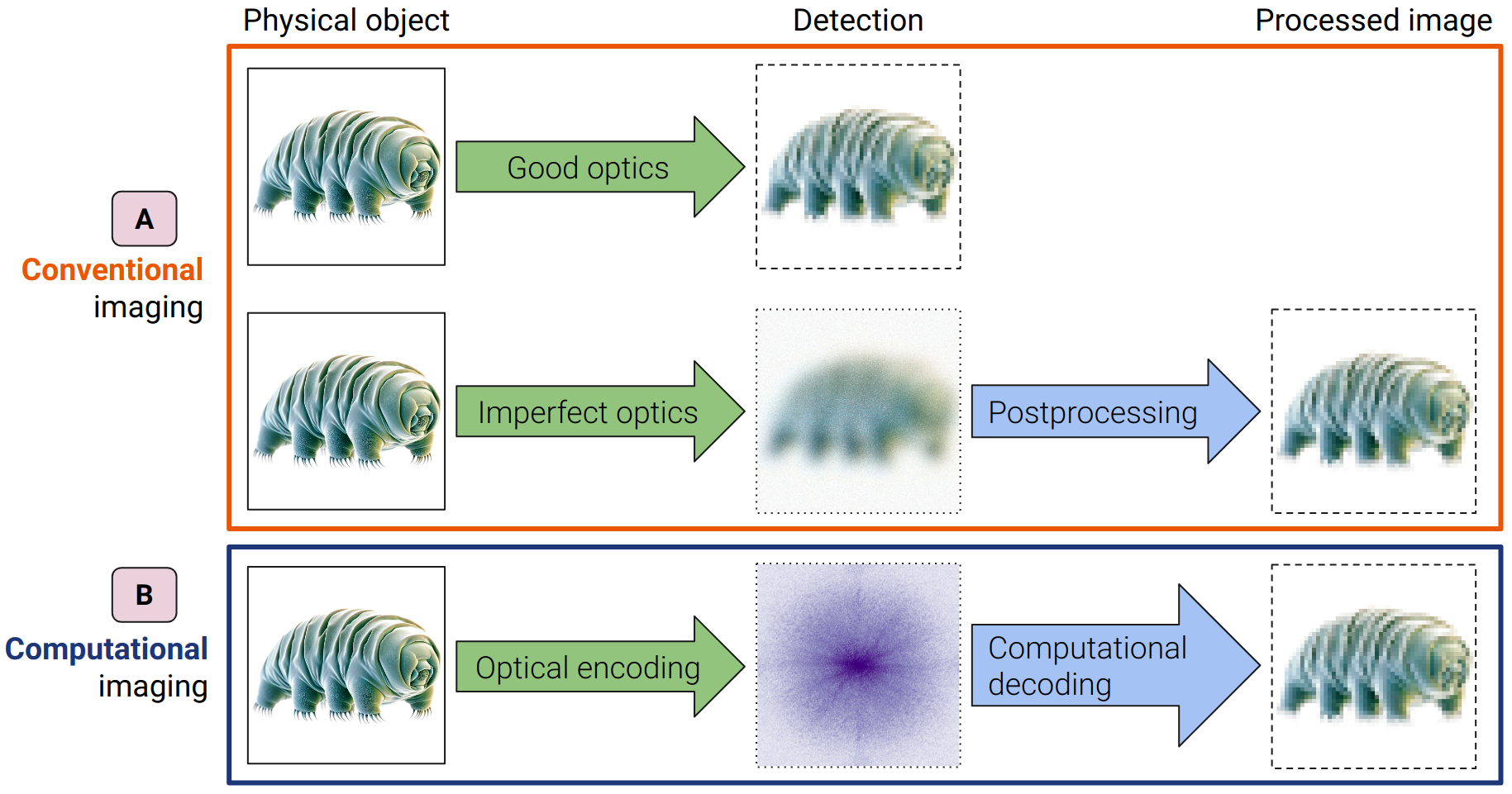
Computational imaging is a novel imaging paradigm that aims to overcome the limitations of traditional imaging systems. Instead of forming a perfect image on a sensor, we measure some derived data (e.g. diffraction patterns) and use a computer to reconstruct the image. This allows us to build simpler imaging systems and to reconstruct information that would otherwise be lost.
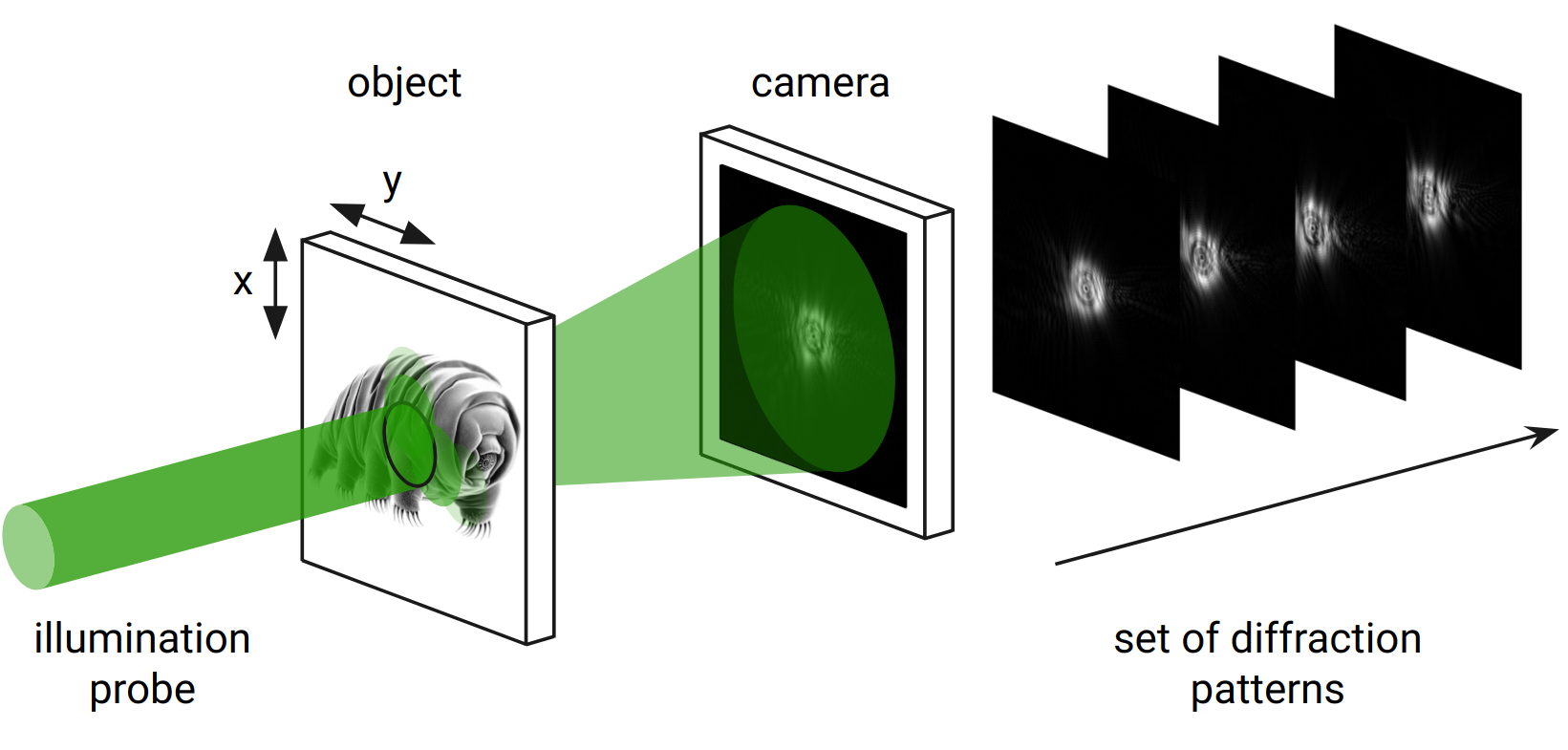
Ptychography is a computational imaging method that uses a series of diffraction patterns to reconstruct the image of a sample. A localized illumination is scanned across a sample, and for each position, a diffraction pattern is recorded. These diffraction patterns are then used to reconstruct the complex-valued transmission function of the sample.
My Ph.D. work in this field has focused on making ptychography more robust and accessible. Here are some selected contributions:
-
Open-source AD ptychography: We developed an open-source ptychography framework based on automatic differentiation (AD) and TensorFlow. This makes it easier for researchers to develop and test new reconstruction algorithms. This work was published in OSA Continuum.
-
Fine-tuning for challenging noise conditions: We developed a method to account for the mixed Poisson-Gaussian noise statistics that are often present in experimental data. This allows for better image reconstruction quality, especially in low signal-to-noise ratio conditions. This work was published in Optics Letters and is also open-source.
-
Semiconductor application and metrology: We demonstrated the use of ptychography for the metrology of semiconductor nanostructures. We developed a wavelength-multiplexed reconstruction algorithm that can handle the instabilities of the EUV sources used in this application. This work was published in Light: Science & Applications.
-
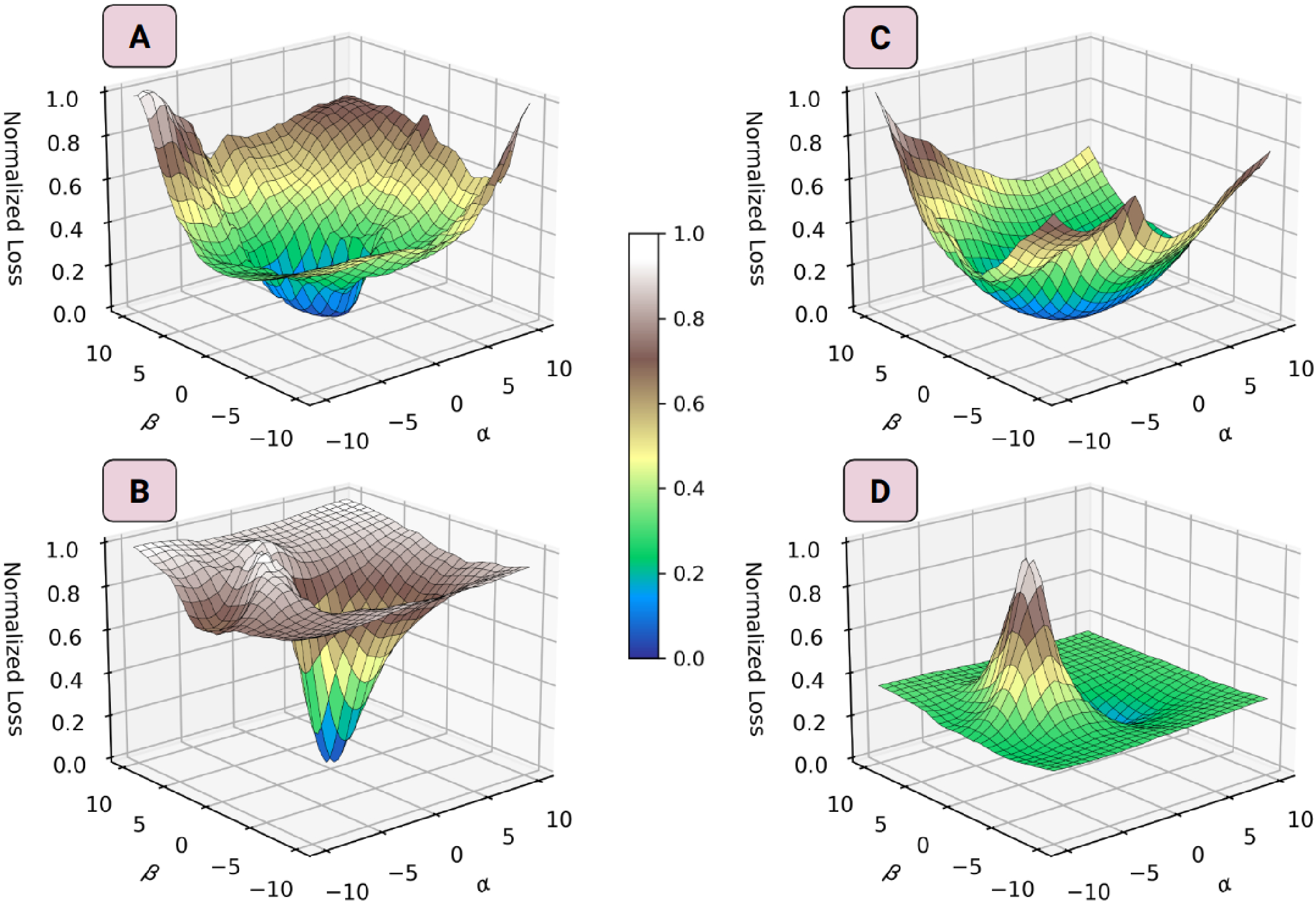
Deep generative models for ptychography: Natural images are often sparse in a latent space. We can visualize this with a latent space walk, which shows smooth transitions within an object class. Implicit rank-minimized autoencoders can be used for this.
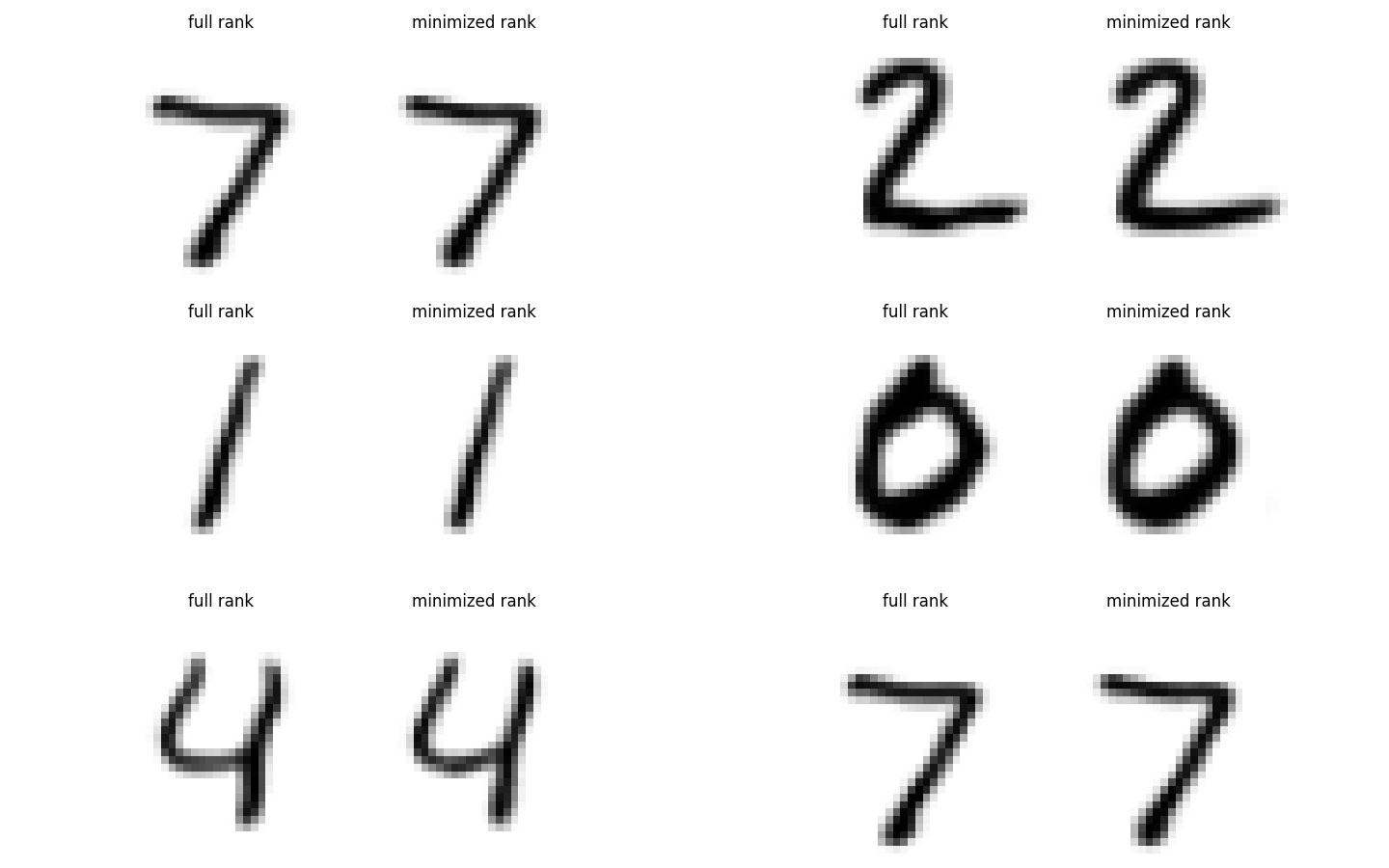
Then, we use this representation in a lower dimension for noise robustness. What I found cool is that we can now approximately visualize the loss landscape of this usually high-dimensional optimization problem (millions of parameters) to study the convexity properties in different noise conditions. This work was published in Optics Express.
Maker Space in Utrecht University
In 2022, with a small team of staff lead from physics/biology/informatics, we set up the first maker space for digital fabrication at Utrecht University: Lili’s Proto Lab. It was a lot of fun working towards this grand opening, and I documented the first wave of (student) projects in the yearly report of 2022.